Monday, October 27, 2008

A Clay Jug Full of Canyons


Today was prop up your good friends day, which I am always more than happy to do. One of the people who needed propping was really at the end of her rope already when she had some old, icky business rear it's head.

"I thought I was done with this! I thought it was out of my life and I wouldn't have to deal with it anymore!" When she was done with her well-deserved freak out, I told her that now I was going to "go all Buddhist on her ass." And proceeded to do so. The reason I did was that what she said clearly resonated for me with what was on my mind with yesterday's post.

Kabir wrote about the clay jug which can contain mountains and canyons and the tools we need to test our mettle (or metal), because we contain everything. All our experiences, every lake we've gazed at, every leaf we've raked, every eclipse we've watched, they exist inside and outside us. We contain them entirely. No matter how many things we make part of our experience, part of us, there is infinite space left.

The upshot of this is that we cannot leave behind our experiences as we contain them, but that bad relationship, tragically embarrassing experience, or profoundly moving moment mean no more, or more less than that moon, that canyon, that raked leaf. They all just are.

Sunday, October 26, 2008

Fingers Pointing to the Moon


Inside this clay jug there are canyons and pine mountains,
and the makers of canyons and pine mountains!

All seven oceans are inside, and hundreds of millions of stars.

The acid that tests gold is there, and the one that judges jewels.

And the music from the strings that no one touches, and the source of all water.

- Kabir (translation by Robert Bly)

I met Erik Storlie Sunday at the MZMC; he was the guest speaker for the Dharma talk and, I learned, one of the founders of MZMC. He shared the Kabir poem above as an example of how we are infinite in scope. Usually, Zen poetry is used to illustrate Zen principles, but although Kabir is many things, a Zen Buddhist is not one of them.

In addition to this poem, he made a reference to the concept of enough (Dayenu) from the Pesach seder. It did my heart so much good to hear him draw from a multiple outside sources. Immersing myself in comparative religion has been an avocation of mine for many years. When I am concentrating on getting clarity on spiritual and philosophical issues, I draw from my exposure to a wide variety of world religions, but Buddhism, most especially Zen Buddhism tends to draw somewhat exclusively from their own (admittedly large) pool of texts and poetry. It was comforting to see someone else feeling free to look outside the proverbial temple for inspiration.

There is a famous teaching that the teachings of the Buddha are like a finger pointing at the moon. Having Judaism, Hinduism, earth spirituality, Sufism, etc. from which to draw from feels like I have many friends with me, all pointing. It seems to me that the more fingers that are pointing, the more easily I can find the moon.

Friday, October 17, 2008

The Place Where You Live

I was cooking some wild rice today and it took me into a place of considering food and place. (If you live in Minnesota, you know that there is no food stuff more associated with this place than wild rice.)

A couple of Septembers ago, my friend Richard was visiting from Hawaii and I said something about, "Oo - it's getting to be risotto season!" To which he responded, "Risotto has a season?" I had to explain to him that when you live in a place where you have seasons, and the temperature can vary as much as 135 deg.F (this is not an exaggeration) over the course of a year, you don't cook things like risotto in the summer (or chili for that matter). He had a real "Aha" moment about place and food; I could see the gears clicking together in his head.

This, then brings me to examining my relationship to place. I've always lived somewhere with seasons; distinct, extreme, defined seasons. I wonder how my life would be different if I lived at a different geography. Somewhere where seasons manifest differently - or, as in Hawaii, there is only one. I cook so seasonally that I wonder how my meals would be different. Would I never make chicken soup again? Would I cook like it was summer all the time or would I adjust to the sameness and begin to vary my menu? As it is, I absolutely cannot eat asparagus out of season; it's just too weird for me, so I must contemplate my relationship to locality and seasonality would be.

Richard was dying for fresh apples when he was here (for which it was, unfortunately, too early). Funny to think of apples as exotic.

My birthday is at the beginning of September, so I am curious as to whether my relationship with my birthday would be different. By the end of August, I am a bit tired of summer, so I wonder if I would tire of the sameness of the seasons or if I would miss the anticipation of the change.

"Stand in the place where you live. Now face north. Think about direction and wonder why you haven't. Stand in the place where you work. Now face West. Think about the place where you live and wonder why you haven't before." – "Stand" by REM.

Friday, October 10, 2008

A Rest Stop in the State of the Sublime


An Adobe Abode
Translation is such a tricky thing. Pali is the original language of the buddhist liturgy and is, essentially, a dead language. Combine this with the cultural gap between modern Westerners and ancient South Asians and translation becomes a tricky thing.

I have a particular interest in the Brahma Viharas which is frequently translated as the "Divine" or "Sublime" Abodes or Abidings, and they are Compassion, Equanimity, Loving Kindness, and Sympathetic Joy (again, there are some translation considerations here).

I felt compelled to get clear about what, exactly, "Abode" or "Abidings" mean. Since translations are the purview of academics, I wanted to see what the linguistics of this phrase are, sending me into Dorky Fascination No. 28: Etymology.

My understanding of the word "abode" was pretty limited, as it (embarrassingly) turns out. I thought that it meant "residence" and "abide" meant "tolerate". I'm not sure how I reconciled the two; basically, I guess I just didn't bother. Although my translations were not incorrect, they were incomplete. "Abode" also means: "stay or continuance in a place; sojourn". Not entirely different from my definition, but different enough in important ways. Abode implies an impermanent resting place. The connotations of this are initially disconcerting. After all, if these are sublime ways of being, aren't they the state we must be in all the time? But if we look at "abide", which in verb form is the present tense of "abode", it can be defined, "To remain stable or fixed in some state or condition; to continue; to remain."

I am taking to a place where I see a place of rest, stability. This is a state where we can find respite. It is an opportunity for repose. When the frustration or dismay over striving to make the Divine Abodes a permanent state of being becomes disconcerting, we can remind ourselves that we can go to them as an interlude or breathing space. Then, be with, enjoy, and appreciate the moments we find ourselves there.

Monday, September 29, 2008

Get a "Life"


It's been a while since I had a must-see TV show. I have several I enjoy, but if I miss them, it's of no large concern. I think the last time I had a show where I refused to answer the phone and on nights I had to miss it, just in case, I double recorded it, was "West Wing". I've been feeling good about the fact that I have not developed any other TV obsession, until now. Fortunately, we now have Fancast so I can watch old episodes and get caught up.

What is this new addiction? "Life". Here's the premise: A cop is falsely convicted of murder. Since he's a cop, the other prisoners regularly beat the crap out of him, his wife divorces him, and he discovers Zen. After 12 years it is discovered that he was falsely accused, is set free with a substantial (at least seven figures) settlement, and goes back on the job. He is now quirky, awkward, and has little to no relationship with, or understanding of, camera phones, instant messaging, and car GPS systems. His Zen education is obviously self-taught and thus he is stumbling toward enlightenment the best he can figure out how.

One of my favorite lines so far is when he is driving his extremely hot new car and he keeps repeating, "I am NOT attached to this car. I am NOT attached to this car. I'm just attached to this car."

Think about it.

Plus it has Robin Weigert in it. I love her. And Adam Arkin. I love him too. I met him once - very handsome.

Tuesday, September 23, 2008

The Buddha Machine vs. Lawn Signs


Many of my friendships are defined by particular characteristics. These characteristics may not be unique to this particular relationship (say, "shoe shopping buddy"), nor are they the sum-total of the relationship, but they are somehow an important part of the identity of that relationship. My friend and, until recently, co-worker, Mats and I have one of those relationships. It is defined by our fondness for weird Asian kitsch. We have been buying each other stuff for years. All of it somewhat inexpensive, all of it amusing.

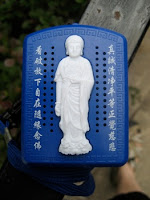
This year for my birthday I received from him the Buddha Machine. Cool, weird, funky (don't know how much he paid for it, so I can't tell you if it was cheap), and wonderful. It is a small, blue, plastic mechanical device from China that plays twelve different Buddhist chants. It comes on a lanyard - need I say more. Not being entirely sure what to do with it, I have hung it in my car where I could be serenaded at will.

Today I was driving to a far suburb, and about half-way there I flipped on the Machine, chose a chant and chilled. I was curious what letting this thing run would be like. It took me a minute or two with several of the chants to really settle into one, but once I did - whoa.

What I Learned:

First of all, chants are something that allow your mind to focus on one, simple thing. Playing chants is a weird thing to do when you're driving. You are both more present, but less alert; or the opposite; or something. At first, it did not permeate my reality that much. Then, suddenly, I understood that the chants were beginning to draw my attention and I wondered if driving and chants were as good a combo as I had initially thought. (I learned a while ago that I couldn't listen to Eckhardt Tolle and drive at the same time.)

Again suddenly, I realized that I was experiencing a synthesis between the driving and the chanting. It was about this time that I hit the edge of the 'burb's residential area. Spread before me about every block or so, was a house with political campaign signs. The majority of these signs were for candidates I have little interest in supporting - some I might even have a tendency to respond to somewhat viscerally. The thing is, by the time I hit the string of lawn signs, I was in a place where I was able to observe them with a breathtaking amount of equanimity (not to mention an ease with simultaneously observing my equanimity!). They were signs. With names on them. Huh.

The Buddha Machine - who knew? As cool as it is, I think I'll be careful/responsible about using this in a moving vehicle. Late nights, for example, would be right out. Nine hour car trips; also probably a bad idea. Respect the Machine.

Tuesday, September 2, 2008

Fig Finale


I ate the rest of the figs. I bought more figs. Lots of them. I am not going to pine over the perfect fig, nor am I going to live my fig-eating life in search of the next perfect fig. I am going to enjoy each and every fig as the fig that it is.

FYI: I did get one very bad fig. You couldn't tell from the outside, but it was FUN-KY on the inside. So, as I have not let the perfect fig ruin my fig eating, neither will I let the evil fig.

No attachment. No aversion. Just eating fruit.